
GYNECOLOGY
IF YOU ARE LOOKING FOR A NEW GYNECOLOGIST?
WE RECOMMEND
MOUNT AUBURN PRACTICE FOR WOMEN AT FRESH POND
@
725 Concord Avenue, Suite 1200, Cambridge, MA 02138
617-503-1000
Fax 617-547-0184
@
725 Concord Avenue, Suite 1200, Cambridge, MA 02138
617-503-1000
Fax 617-547-0184
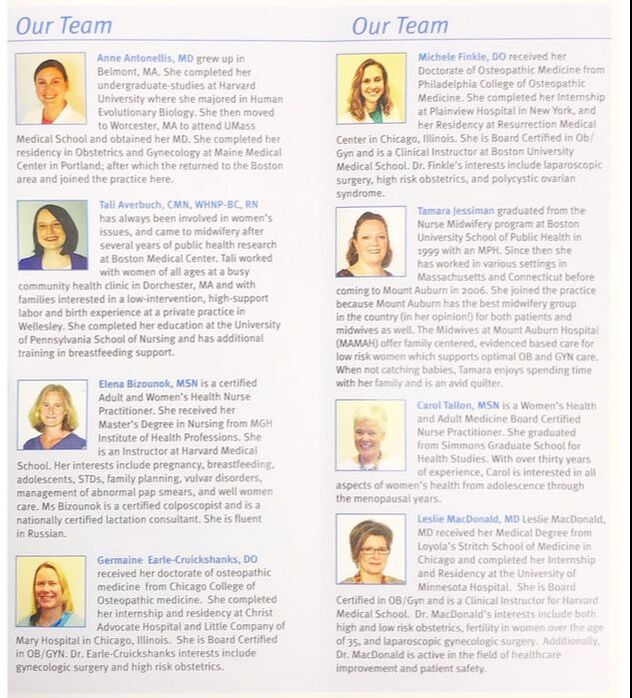
PROVIDERS:
- Leslie MacDonald, MD
- Germaine Earle-Cruickshanks, MD
- Michele Finkel, MD
- Anne Antonellis, MD
- Elena Bizounok, NP
- Carol Tallon, NP
- Tamara Jessiman, CNM
- Tali Averuch, CNM
For educational information about GYN conditions supplied by the American Congress of Obstetricians and Gynecologists click HERE
It may be time for your annual checkup. If you're like most women, you may wish you could go back to the time when "checkup" meant a few taps on the chest with a stethoscope and walking away with a lollipop in hand. As a grown woman you have more serious — and sometimes, more invasive — things to look forward to. But the annual once-over doesn't have to be a major source of anxiety, especially if you're prepared. Here, a decade-by-decade guide to getting the best exam possible.
Tests Every Woman Needs:
Everyone should get a standard yearly physical, during which you can expect a few basics — no matter what your age. Among them: height, weight and a head-to-toe skin check for any suspicious moles that might signal cancer. If you have a family history of certain diseases or if you have specific health concerns, you might also get a blood test that checks things such as your blood's iron level or your thyroid function. And if you have any special risk factors for coronary heart disease — that is, if you smoke, are very overweight, have diabetes or high blood pressure, or if you've had a close female relative who developed heart disease before age 65 — we may recommend an EKG or a chest X-ray.
Regardless of whether your primary care physician is an internist, a family practitioner or an ob-gyn, you should get a Pap test at least every three years (some doctors recommend them annually). During this procedure, a small tool to scrape a bit of tissue from the cervix; these cells will be tested for abnormalities that might indicate cancer. Pap tests also can detect human papillomavirus, or HPV, a sexually transmitted disease that can increase a woman's risk of developing cervical cancer.. Plus, every 10 years, you should get a booster shot against tetanus and diphtheria.
If You're 20 or Older...
In your 20s, in addition to the tests outlined above, you should also get your cholesterol checked; if it's normal, the test should be repeated every five years. You should also be provided with some general health and wellness counseling e.g. the importance of doing breast self-exams and practicing safe sex.
If You're 30 or Older...
When you're in your 30s, you can look forward to roughly the same tests and exams that you got in your 20s, plus any discretionary tests your doctor orders (for example, a mammogram if you have a family history of breast cancer). Also, your birth-control regimen may change, depending on whether you are trying to get pregnant or think you're finished with childbearing.
At 35, you should also start paying attention to your bones, whether that means doing weight-bearing exercise. (Pumping iron in the gym or starting a power-walking regimen) and getting enough calcium. Most women don't require a bone-density exam for another 15 years, but those who are significantly underweight or who've had an eating disorder may need the test early; that's because women who are very thin can stop having periods — and stop producing the estrogen that's required to maintain healthy bones.
If You're 40 or Older...
Beginning at age 40, you can add a mammogram to your health exam checklist. (Mammograms, which screen for breast cancer, are recommended every other year from ages 40 to 50, and annually after that.) Your doctor may also begin to focus on your diet and fitness, since this is the age at which most women put on weight. Another addition to your annual physical is screening for colorectal cancer by checking a fecal occult blood test, which evaluates any blood in your stool.
And even though the average age of menopause is 51, many women in their 40s are curious and/or apprehensive about the signs and symptoms of this upcoming hormonal shift. Women realize that there's a connection between menopause and lifestyle, and they may want to know more about the alternative things they can do.
If You're 50 or Older...
At age 50 you should have a screening colonoscopic examination to detect colon polyps and colorectal cancer. If there is a family history of colon cancer, screening for this should start at age 40. Beginning at menopause, you should add a bone density exam as well as a thyroid test to your checkup. (If you show signs of a thyroid problem, such as significant weight gain and persistent fatigue, you might be given this test earlier.) The Shingrix vaccine (2 shots) are advised after age 50. The influenza vaccine should be received annually, but at 64 and 65, you'll also be advised to get the Prevnar-13 first and the Pneumovax-23 pneumonia vaccines, although women with asthma or other respiratory diseases may need these earlier.
